
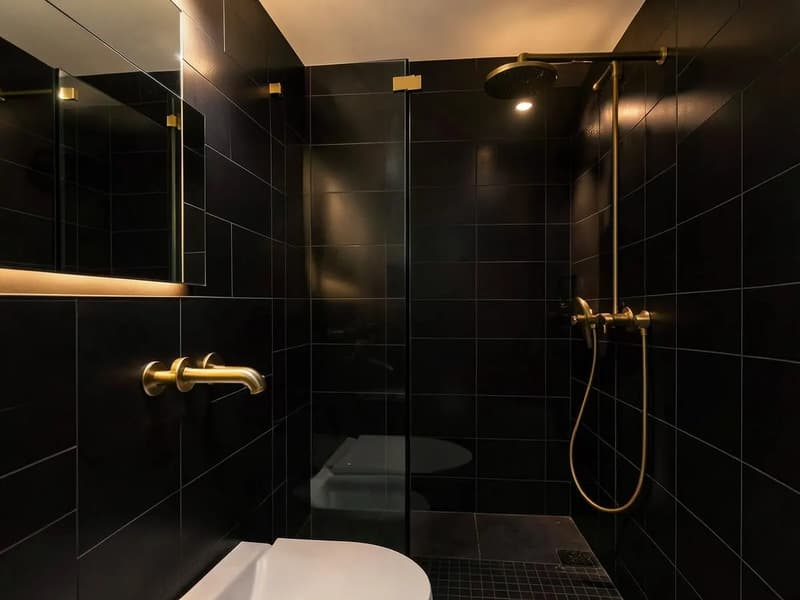
Need help with walk-in shower installation? Get a quote from Herts and Essex Renovations.
Bath screens or walk-in panels
A bath screen is a hinged or fixed panel fitted to the rim of a bath with a shower over it. It is compact and lets you keep a bath, but water can escape past its open end, especially with a wide shower head. Hinged screens are handy for cleaning; fixed ones seal better.
A walk-in panel is a single fixed glass panel beside a tray or a level shower floor, with no door. It needs enough length and a well placed shower head so the spray stays behind the glass. Our walk-in shower cost guide covers the tray, drainage and floor work that usually goes with one.
Read more: Walk-in shower installation cost
Fixing into tiles and what is behind them
Screens are screwed through the tiles into the wall behind. On a masonry wall that is straightforward with the right drill bit and plugs. On a stud wall, the fixings need timber noggins or a solid backer board behind the tile, ideally put in before tiling. Drilling tiles is done slowly with a tile bit and no hammer action, starting through masking tape so the bit does not wander.
Every hole through the tile is a potential route for water, so fixings are sealed as they go in. Drilling into a pipe hidden in the wall is the other risk, which is why we check pipe routes before marking up.
Wall channels, profiles and silicone
Most screens hang from a wall channel that lets the glass be adjusted a few millimetres to sit perfectly upright even if the wall is slightly out. The channel is checked with a level before the glass is clamped.
Silicone goes on the outside of the screen and channel, where it stops water escaping onto the floor. The inside is left unsealed along the bottom so that water which runs down the glass or behind the channel can drain back into the tray rather than being trapped.
Walk-in shower installation
- Low trays, fixed screens and level-access formers
- Wet areas tanked and set to accurate falls
- Old baths swapped for a walk-in shower
Glass and screen size
Screens use toughened safety glass, often with a coating that helps water run off. Thicker glass feels more solid and is common on larger walk-in panels. Length matters most: a short screen with a powerful head will always let water past. As a rule, the screen should extend well beyond where the spray lands, and a return panel or a deflector can help in a tight space.
Why screens leak, and how to stop it
Water on the floor usually comes from one of four places: the open end of the screen, a bath or tray that has dropped and pulled away from its silicone, a missing seal along a hinged edge, or failed grout and silicone in the corner. Spotting which one it is avoids replacing a screen that was never the problem. Why showers leak looks at each cause in more detail.
Read more: Why showers leak
Replacing a screen or the whole enclosure
Swapping an old bath screen for a new one is usually a short job, although the old fixing holes need filling or hiding behind the new channel. If the tray is cracked, the tiles are loose or the corner is mouldy behind the silicone, replacing only the glass will not solve it. In that case a new tray, fresh waterproofing and possibly a move to a walk-in layout or wet room may make more sense, which the walk-in shower or wet room guide compares.
Read more: Walk-in shower or wet room
Cleaning and looking after a new screen
The silicone around a new screen needs time to cure before the shower is used, so follow the curing time on the product rather than testing it the same evening. Once it is in use, a squeegee after each shower is the simplest way to stop limescale building up on the glass, especially in hard water areas where white marks appear quickly.
Avoid abrasive pads and strong descalers on coated glass, because they wear the coating away and make the screen harder to keep clean. Check hinges and seals every so often; a loose hinge screw or a split seal along the edge lets water out long before the glass itself is at fault. If silicone starts to blacken with mould that will not clean off, it is better to cut it out and reseal than to paint over it, because mould under the surface usually means water is getting behind it.
Want a professional to handle it?
Send us the room details and we will come back with a written quote, or call us for a chat first.
Common questions
- Can a shower screen be fitted to existing tiles?
- Yes, as long as the tiles are firmly bonded and the wall behind gives a solid fixing. Holes are drilled carefully and sealed.
- Why does water get out past my bath screen?
- Usually through the open end, from a shower head aimed at the gap, or through a missing seal along the hinge or bottom edge.
- How wide should a walk-in shower panel be?
- Wide enough to extend well past where the spray lands. The shower head position and the space beside the glass matter as much as the panel itself.
- Do shower screens need silicone on the inside?
- Not along the bottom. Silicone goes on the outside so any water that gets behind the glass can drain back into the tray.
The service behind this guide
Covering Hertfordshire and Essex.