
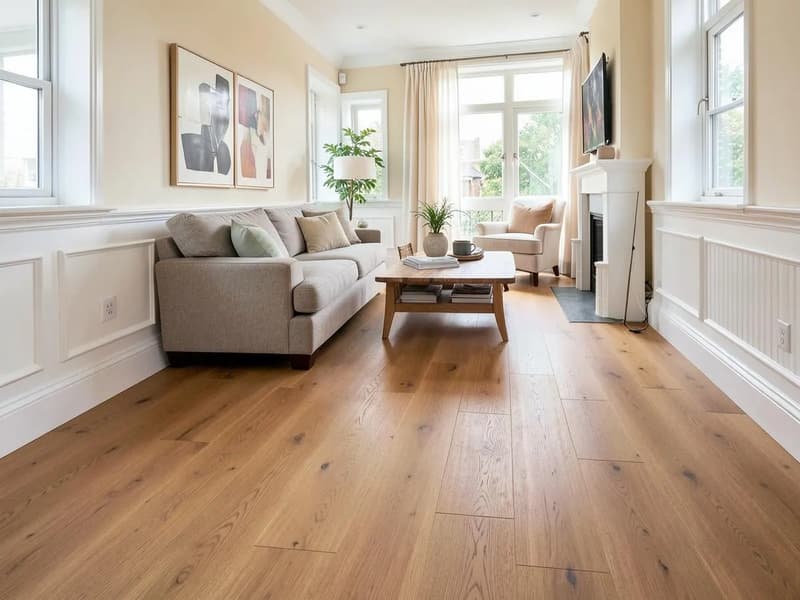
Need help with lvt flooring fitting? Get a quote from Herts and Essex Renovations.
Similar appearances, different materials
Both can imitate timber, and both come in finishes that look convincing in a small sample. Judge the scale of the printed pattern and its repetition across a room, not just one board. Texture, edge detailing and the range of available trims also influence the finished appearance.
LVT may also imitate stone or tile, while laminate is commonly chosen for plank-style rooms. Neither name establishes the thickness, durability specification or joint design. Compare identified products with their technical information rather than treating the cheapest and most substantial versions as equivalent examples of a material.
How water changes the choice
Vinyl-based material generally handles water differently from the board core in laminate. That can make a bathroom-permitted LVT attractive, but installation details and the base still matter. Water passing through a joint or around an edge can reach materials below even if the visible surface itself remains unchanged.
For laminate, the permitted exposure and room types must be read carefully. Moisture-resistant boards and sealed joints do not necessarily mean standing water or wet room use is allowed. Do not leave spills because of a marketing description. If water is already coming from a leak, correct that before comparing replacement products.
Comfort, noise and the floor beneath
LVT and laminate can feel different underfoot, depending on their thickness, installation system and the base. A bonded vinyl floor and a floating laminate floor do not behave in the same way. Samples help with surface texture but cannot show the sound of the full installed assembly.
Underlay choices belong to the product specification. An overly soft layer can create problems at locking joints rather than making the floor better. In a flat, any requirements concerning impact sound should be checked separately. Neither product should be selected on an unsupported promise that it will silence every noise in the building.
Fitting systems and preparation
Glue-down LVT requires a compatible smooth prepared substrate and adhesive arrangement. Click LVT has its own requirements for flatness and movement. Laminate is commonly floating with specified underlay and expansion allowances. These are not interchangeable methods, even where the boards look similar.
The condition of the old floor can influence preparation more than the material choice. Removing a carpet, taking up tiles or dealing with an uneven base are different tasks. Our LVT fitting and laminate fitting pages describe those installation enquiries. Compare preparation as well as fitting when asking which system is practical for your rooms.
Read more: LVT flooring fitting, Laminate flooring fitting
Free quote
Need it sorted? Book LVT flooring fitting
Describe your rooms and preferred finish. Ask for the preparation, fitting and edges to be included in a written quote.
Cleaning and long-term care
Follow the instructions for the chosen finish. Too much water, unsuitable chemicals or abrasive treatment can affect a floor even when routine wiping is straightforward. Protect the surface from grit and use suitable furniture feet rather than assuming a wear description removes the need for care.
Think about how the room is used: a hall with outdoor footwear, a dining space with moving chairs and a bathroom have different priorities. Compare stated wear suitability and maintenance, not a general claim that one material never scratches. Replacement of an individual piece also depends on the system and access, not simply on its being a plank.
Heating and connected rooms
Where underfloor heating exists or is planned, check the complete floor and heating combination. Temperature limits and the effect of underlay or adhesive need considering. Changing the covering can alter performance, so keep the heating installer involved where necessary rather than relying on the old arrangement working with any replacement.
A continuous visual finish across several rooms may require physical breaks that are not obvious in an inspiration photograph. Product run limits, doorway transitions and differing moisture conditions govern the design. Discuss where the bathroom or kitchen joins the hall and how the visible edges will be finished.
Which one suits your priorities?
Choose LVT where a permitted vinyl system matches the room conditions and you prefer its feel or appearance. Choose laminate where the specified product suits the location and you value its plank finish. A suitable laminate in a dry bedroom may be a better decision than an unsuitable LVT bought without checking the installation needs.
If real timber is also on your shortlist, the engineered wood comparison addresses that different choice. For the fitting quote, send the product details, rooms and existing base information. Ask for removal, preparation and transitions to be included so the choice is based on the actual installation rather than a material name alone.
Read more: Engineered wood versus LVT
Want a professional to handle it?
Send us the room details and we will come back with a written quote, or call us for a chat first.
Common questions
- Is LVT better than laminate?
- It depends on the room and products. Bathroom-permitted LVT can be more suitable where moisture is a concern, while laminate may suit dry living spaces. Compare construction, fitting requirements, maintenance and the exact permitted use rather than choosing a universal winner.
- Can you put LVT in a bathroom?
- Yes where the specific product and installation system permit it and the base and edges meet its requirements. That does not automatically permit wet room shower-floor use or make the structure underneath waterproof.
The service behind this guide
Covering Hertfordshire and Essex.