
Fitted cost per square metre
Supplied and fitted, including underlay or adhesive and standard subfloor preparation.
| Laminate | £28 to £45 per m2 | Cheapest, least water tolerant |
|---|---|---|
| LVT, click system | £45 to £70 per m2 | Quick to lay, easy to replace a plank |
| LVT, glue down | £60 to £95 per m2 | Best over underfloor heating |
| Engineered wood | £70 to £130 per m2 | Real timber wear layer, can be sanded |
Water, kitchens and bathrooms
LVT is waterproof and unbothered by a dishwasher leak or a wet dog. Engineered wood tolerates a spill wiped up quickly but will cup if water sits at a joint. For kitchens, utilities and anywhere near a back door, LVT is the safer choice.
Underfloor heating
Glue down LVT is the best performer over underfloor heating because it sits in direct contact with the screed and transfers heat efficiently. Engineered wood works too, provided the board is wide enough, the surface temperature is limited to 27 degrees and the floor is brought up to temperature slowly.
How each looks after five years
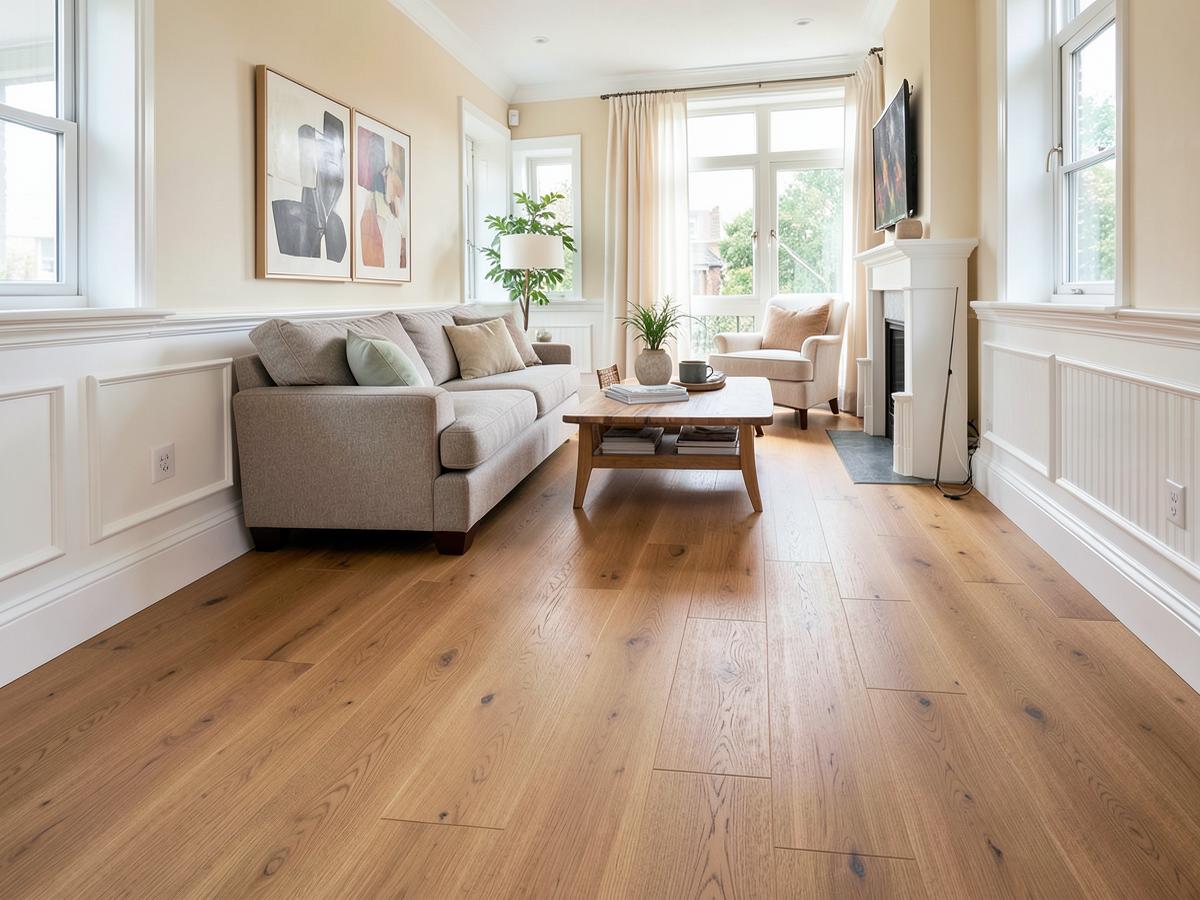
Engineered wood picks up character. Scratches read as patina, and a 4mm wear layer can be sanded and refinished once or twice, so a hallway can be brought back rather than replaced.
LVT stays exactly as it was until it does not. It does not scratch easily, but a deep gouge cannot be sanded out, so you replace the plank instead, which is why we always leave spare boxes with the client.
Common questions
- Is LVT cheaper than engineered wood?
- Yes, usually by around a third once fitted. Click LVT typically lands at £45 to £70 per square metre against £70 to £130 for engineered wood.
- Can engineered wood go in a kitchen?
- It can, and it looks superb, but you accept the risk of cupping if a leak sits unnoticed. If you have young children or a dog that comes in wet, we would steer you to LVT.
- Which is better over underfloor heating?
- Glue down LVT, because it makes full contact with the screed. Engineered wood is fine too if the surface temperature is properly limited.
- Does the subfloor need levelling for either?
- Yes, and this is where most floor failures start. LVT in particular telegraphs every bump underneath it, so we latex or overboard until the subfloor is genuinely flat.
- Can one floor run through the whole ground floor?
- Yes, and it makes a house feel considerably larger. We plan the expansion gaps and any necessary movement joints so a continuous run does not buckle in summer.