
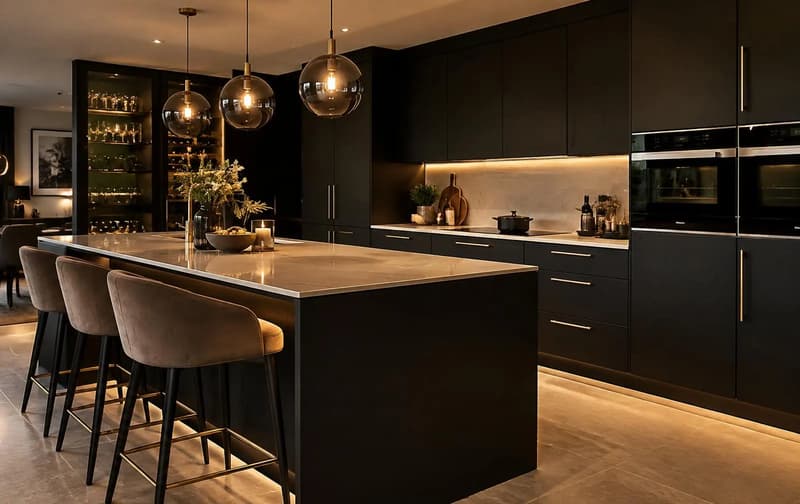
Quartz: the low maintenance stone
Quartz is an engineered stone, so the colour and pattern run evenly from one piece to the next. That makes joins easier to hide and means the sample you choose looks like the finished kitchen. It is non porous, so spills wipe away and it never needs sealing.
Its weak spot is direct heat. A pan straight off the hob can mark it, so a trivet beside the hob is a good habit.
Granite: natural stone with character
Granite is quarried rather than made, so every slab has its own movement and colour variation. It copes with heat better than quartz, but it is porous enough to need sealing. Where two pieces join, we plan the layout so the pattern flows as well as the stone allows.
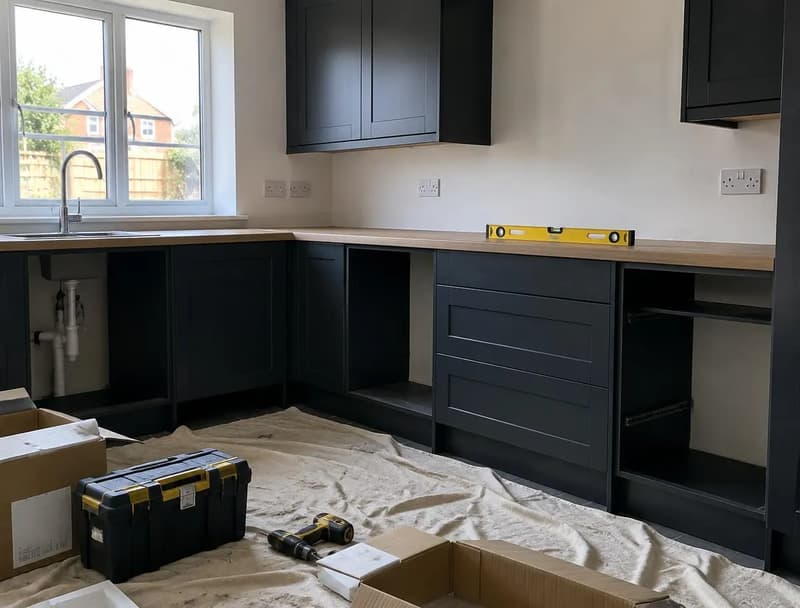
Solid wood as the alternative
Solid wood brings warmth that stone cannot, and scratches can be sanded out. It needs regular oiling and room to move with the seasons, especially near the sink. Our guide to living with solid wood worktops explains the care involved before you commit.
What templating involves
Stone worktops are made to measure off site, so they are templated after the units are fixed and level. The template captures the wall lines, overhangs, the sink and hob positions, tap holes and any drainer grooves. Nothing about the units should change between templating and fitting, which is why we finish any carcass repairs first.
On fitting day the pieces are set on the units, joints are bonded and polished, and the sink and hob are connected and tested.
Fitting as part of a wider job
Stone tops can go on as part of a full kitchen installation or onto your existing units through our worktop replacement service. Either way the survey, written quote and day by day plan work the same.
Thickness, edges and overhangs
Stone worktops commonly come in a slimmer or a chunkier thickness, and the choice changes both the look and the weight the units carry. Edge profiles range from a simple square or slightly eased edge to rounded and bevelled styles. A breakfast bar or island overhang needs enough support underneath so the stone is never left unsupported over a long span.
We talk these details through at the survey so the template and the order match exactly what you want.
Quartz and granite questions
- How much are quartz worktops in the UK?
- Our kitchen worktop cost guide sets out typical prices per metre for quartz, granite, wood and laminate. The final figure depends on the colour, thickness, length, joints and cut-outs, which your written quote itemises.
- How much does a quartz worktop cost for my kitchen?
- It comes down to the total length, how many joints and cut-outs there are, the edge profile and the thickness you choose. We measure up at the survey and price your own kitchen in writing.
- Is quartz or granite better for a family kitchen?
- Quartz in most cases, because it never needs sealing and resists staining. Granite is better if you often put hot pans down.