
Need help with tiling? Get a quote from Herts and Essex Renovations.
Kitchen splashback ideas that suit everyday use
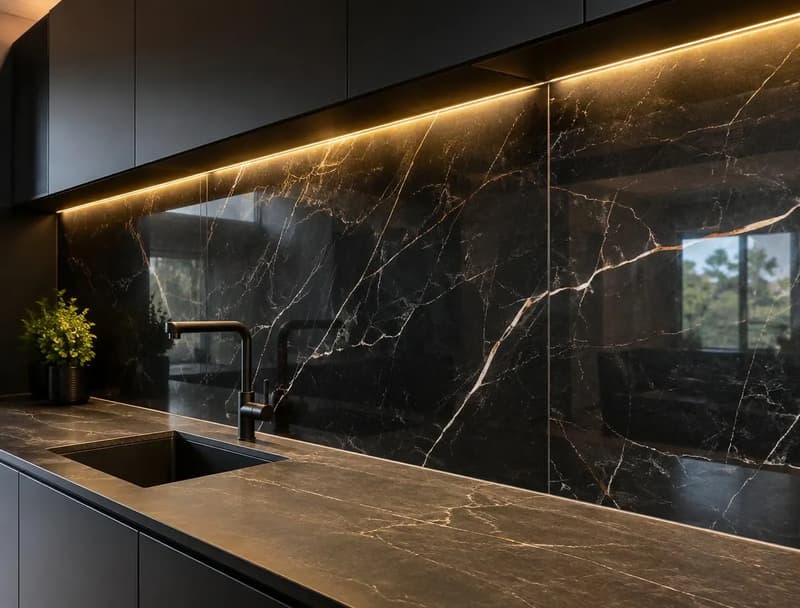
Metro tiles laid in a brick bond remain popular because they suit shaker and handleless kitchens alike. Laying them vertically or in a herringbone pattern changes the look completely without changing the tile. Square zellige style tiles give a handmade, uneven finish that hides the odd splash. Large porcelain slabs give an almost seamless wall with very few grout lines to clean.
Behind the hob, choose a glazed or porcelain tile rather than an unsealed natural stone, which can mark with oil and heat. Darker grout is far easier to live with than white on a busy cooking wall.
Read more: Kitchen tiling service
- Metro in brick bond, vertical stack or herringbone
- Handmade style squares for texture
- Large porcelain panels for fewer grout lines
- Patterned tiles as a feature behind the hob only
Full height, half height or upstand
A short upstand of a tile or two protects the joint where worktop meets wall and keeps the rest of the wall painted. Half height tiling runs up to the underside of the wall units. Full height tiling continues to the ceiling where there are no wall units, often around a window or behind open shelves. Each option needs a different number of tiles and a different amount of cutting, so decide early.
Set out around sockets, windows and the hob
Before fixing a single tile, we work out where the full tiles and the cut tiles will land. The aim is to centre the pattern on the most visible feature, usually the hob or the window, so the cuts at each end are equal. A thin sliver of tile at the end of a run, or beside a window reveal, is the giveaway of a splashback that was started in a corner and hoped for the best.
Sockets and switches are cut around neatly, and where possible their backboxes are set so the faceplate sits flat on the tile. Window reveals get a mitred edge or a trim rather than an exposed cut edge.
Tiling
- Set out from the centre line
- Large format porcelain and natural stone
- Mitred edges, grouting and sealing
Why tiling comes after worktop templating
Splashback tiles sit on the worktop, so the worktop has to be fixed first. With laminate or wood that can be within days of the units going in. With stone or quartz, a templater measures once the units are fixed and level, and the slabs are cut before they are fitted. The splashback follows after that, which is why it often lands in the second half of a kitchen programme.
Tiling before the worktop is in leaves a gap that has to be filled with silicone or a strip of cut tile, and it never looks as clean.
Grout, sealing and finishing
Kitchen grout takes grease and cooking splashes, so we use a stain resistant grout and leave a flexible silicone joint where the tiles meet the worktop, because that joint moves slightly as the house moves. Natural stone tiles are sealed before and after grouting. The finished edges at the end of each run are either mitred or trimmed so no raw tile edge is on show.
What changes the cost of a tiled splashback
The area to be tiled, the tile size and pattern, the number of sockets and window reveals to cut around, and whether the wall needs preparing all change the price. Small mosaics and herringbone take longer than a simple brick bond. We include splashback tiling in the kitchen quote when it is part of the job, itemised so you can see it.
Want a professional to handle it?
Send us the room details and we will come back with a written quote, or call us for a chat first.
Common questions
- When should a kitchen splashback be tiled?
- After the worktop is fixed. With stone or quartz that means after templating and fitting, usually in the second half of the kitchen programme.
- What tiles are best behind a hob?
- Glazed ceramic or porcelain, which cope with heat and grease. Unsealed natural stone can mark more easily.
- How do you avoid thin cuts at the ends?
- We set out the tiles from the hob or window first, so the cuts at each end of the run are equal.
- Can you tile around sockets neatly?
- Yes. Tiles are cut around each faceplate, and backboxes are set so the faceplate sits flat on the tile where possible.
- Do you fit splashbacks as part of a kitchen job?
- Yes. Splashback tiling is included in our kitchen installations and shown as its own line on the written quote.
The service behind this guide
Covering Hertfordshire and Essex.