
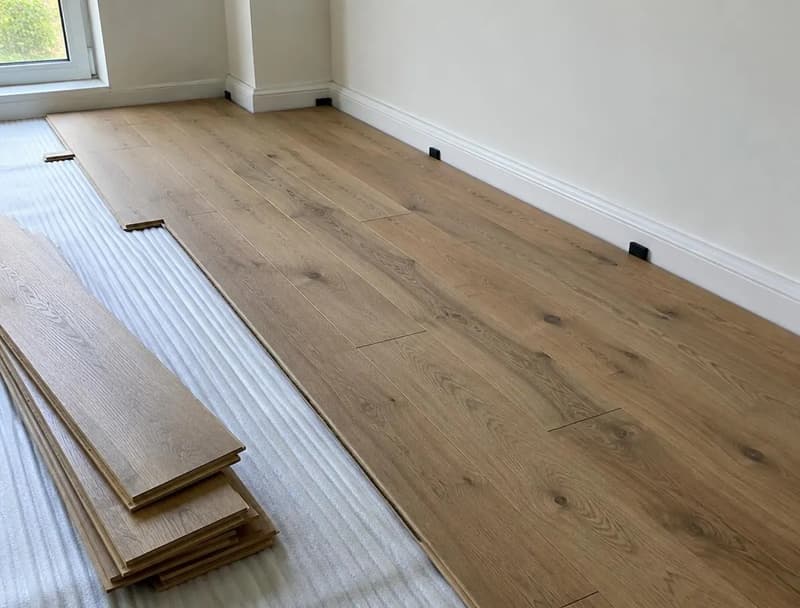
Why an uneven floor matters
Thin floors such as LVT show every ridge and hollow, click floors flex and creak over dips, and tiles laid on a bumpy base end up lipped or cracked. Even engineered wood needs a reasonably flat base to stay quiet underfoot. Levelling first is what makes the finished floor look and feel right.
If you are planning LVT flooring, preparation is especially important because it is so thin.
Concrete floors and levelling compound
On a concrete base we clean off old adhesive and loose material, prime the surface and pour a self levelling compound that flows out to a flat finish. Deeper hollows may need filling first. Damp readings are taken before anything is laid, and a membrane is added where needed.
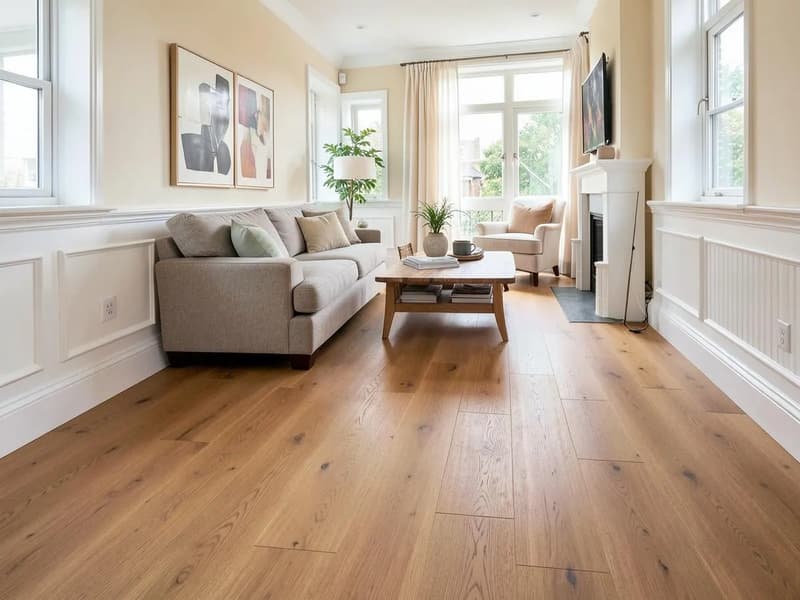
Timber floors and overboarding
On suspended timber floors, loose or squeaky boards are screwed down, and the floor is often overboarded with ply to give a firm, flat surface. That spreads the load and stops movement in the old boards from reaching the new floor or cracking tile grout.
Screeding, in general terms
A floor screed is a thicker layer, usually laid over a new concrete slab or around wet underfloor heating, and it needs much longer to dry. It is a different job from levelling an existing floor. Most renovation floors we see need preparation and levelling compound rather than a new screed, and we will explain what your floor needs at the survey.
Part of the flooring job
Levelling is priced as part of laying your new floor, not as an afterthought. The written quote separates preparation from laying so you can see what each part costs. Our main flooring page covers the floors we fit, and our guide to sorting an uneven subfloor explains how to spot the problem yourself.
Moisture, doorways and thresholds
Levelling also deals with the details around the edges. A new floor and its levelling layer add height, so we check door clearances and plan thresholds so rooms meet without a trip point. Where concrete reads damp, a membrane goes down before levelling, because moisture coming up through a slab will spoil adhesives and wood floors.
Old floor coverings, tile adhesive and bitumen residue are removed or sealed first, because levelling compound will not bond to a weak or contaminated surface.
Floors we level for
Levelling suits almost every floor we lay. LVT and tile need the flattest base, engineered and solid wood need a firm one, and laminate needs a level surface so the click joints do not strain. Herringbone, which is set out from the centre of the room, shows any unevenness along its lines more than plank, so preparation counts double there.
If underfloor heating is going in, the levelling layer is often what the mat or cable is embedded in, so the two jobs are planned together.
Floor levelling questions
- How do I know if my floor needs levelling?
- Lay a long straight edge across it. Gaps under the edge, bounce when you walk, or squeaks all suggest preparation is needed before a new floor.
- How long before a levelled floor can be covered?
- It depends on the compound and thickness. Thin levelling layers are usually ready far sooner than a full screed, and we build the drying time into the programme.
- Can you level just one room?
- Yes. We prepare and level single rooms or run the preparation through a whole ground floor.