
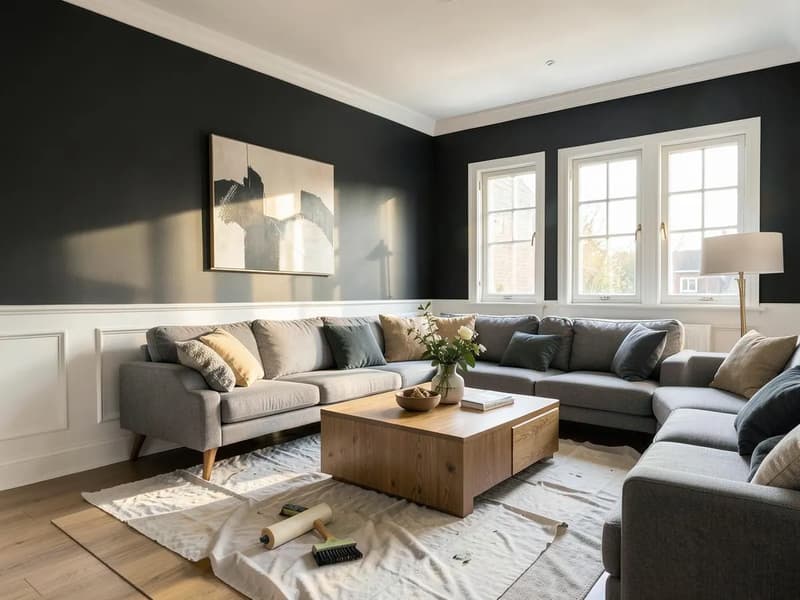
Need help with painting and decorating? Get a quote from Herts and Essex Renovations.
Render and masonry preparation
Painted render and brick collect dirt, algae and loose paint. We brush and wash the walls, treat green growth, rake out and fill cracks, and scrape back any flaking paint until what is left is sound. Bare patches are primed or stabilised so the new coat bonds evenly across the wall.
Masonry paint is designed to let walls breathe. Sealing a damp wall in with the wrong product traps moisture and pushes the paint off from behind, so we choose the coating to suit the surface.
Read more: Arrange exterior painting
Exterior woodwork
Windows, doors, fascias, soffits and bargeboards take the worst of the weather. Loose and blistered paint is scraped and sanded, soft timber is cut out and repaired, knots are sealed and bare wood is primed. Glazing seals and joints are checked, and gaps are filled with a flexible exterior filler. The topcoats then go on in thin, even layers that can move with the timber.
- Scrape and sand failed paint
- Repair soft or rotten sections
- Knot seal and prime bare timber
- Fill joints with flexible exterior filler
- Undercoat and topcoat in dry conditions
Choosing the right weather window
Exterior paint needs a dry surface, a dry forecast and temperatures that let it cure. Painting straight after rain, too early on a dewy morning or late on a cold afternoon is how coatings fail early. In practice that means most exterior work in our area is done from late spring to early autumn, and the programme is planned with some flexibility for wet days.
We work around the sun as well, painting walls after the sun has moved off them, so the paint does not dry too fast and leave lap marks.
Painting and decorating
- Full preparation, filling and sanding
- Interior walls, ceilings, woodwork and staircases
- Wallpaper hanging and removal
Access, ladders and platforms
How the walls can be reached affects both safety and price. A bungalow can often be done from ladders and steps. A two or three storey house, or one with a conservatory or extension roof in the way, may need towers or scaffolding. Narrow side passages, steep gardens and neighbouring roofs all play a part, and we assess them at the survey.
What decides the cost to paint the exterior of a house
The main factors are the area of wall, the height and access, the condition of render, brick and woodwork, how much repair is needed, and the number of coats for any colour change. Woodwork usually takes longer per metre than walls because of the detail. Our written itemised quote separates walls, woodwork and access, so you can see each part.
Inside and outside together
If you are having interior work done with us, exterior woodwork can be scheduled for dry days while indoor rooms carry on when it rains. That keeps the programme moving whatever the weather does, and the house is finished inside and out on one quote.
How long exterior painting takes
An average house usually takes a number of dry days rather than a fixed calendar week, because rain stops exterior work. Preparation takes the first part of the job, followed by primer on repaired areas, then undercoats and topcoats with drying time between each. Woodwork tends to set the pace, because every window frame, sill and door needs care. We plan the order so the highest work is done first and nothing above a finished surface is disturbed afterwards.
Want a professional to handle it?
Send us the room details and we will come back with a written quote, or call us for a chat first.
Common questions
- When is the best time to paint the outside of a house?
- Late spring to early autumn, on dry days with a dry forecast and surfaces that are free of rain or dew.
- Do you paint render and masonry?
- Yes. We clean, repair and prepare render and masonry, then apply a breathable masonry coating.
- Do you paint exterior woodwork?
- Yes. Windows, doors, fascias, soffits and bargeboards are prepared, repaired where needed, primed and painted.
- What affects the cost of exterior painting?
- Wall area, height and access, surface condition, repairs and colour changes. We itemise each in the written quote.
- Will I need scaffolding?
- Not always. It depends on the height of the house and what sits beneath the walls, which we assess at survey.
The service behind this guide
Covering Hertfordshire and Essex.